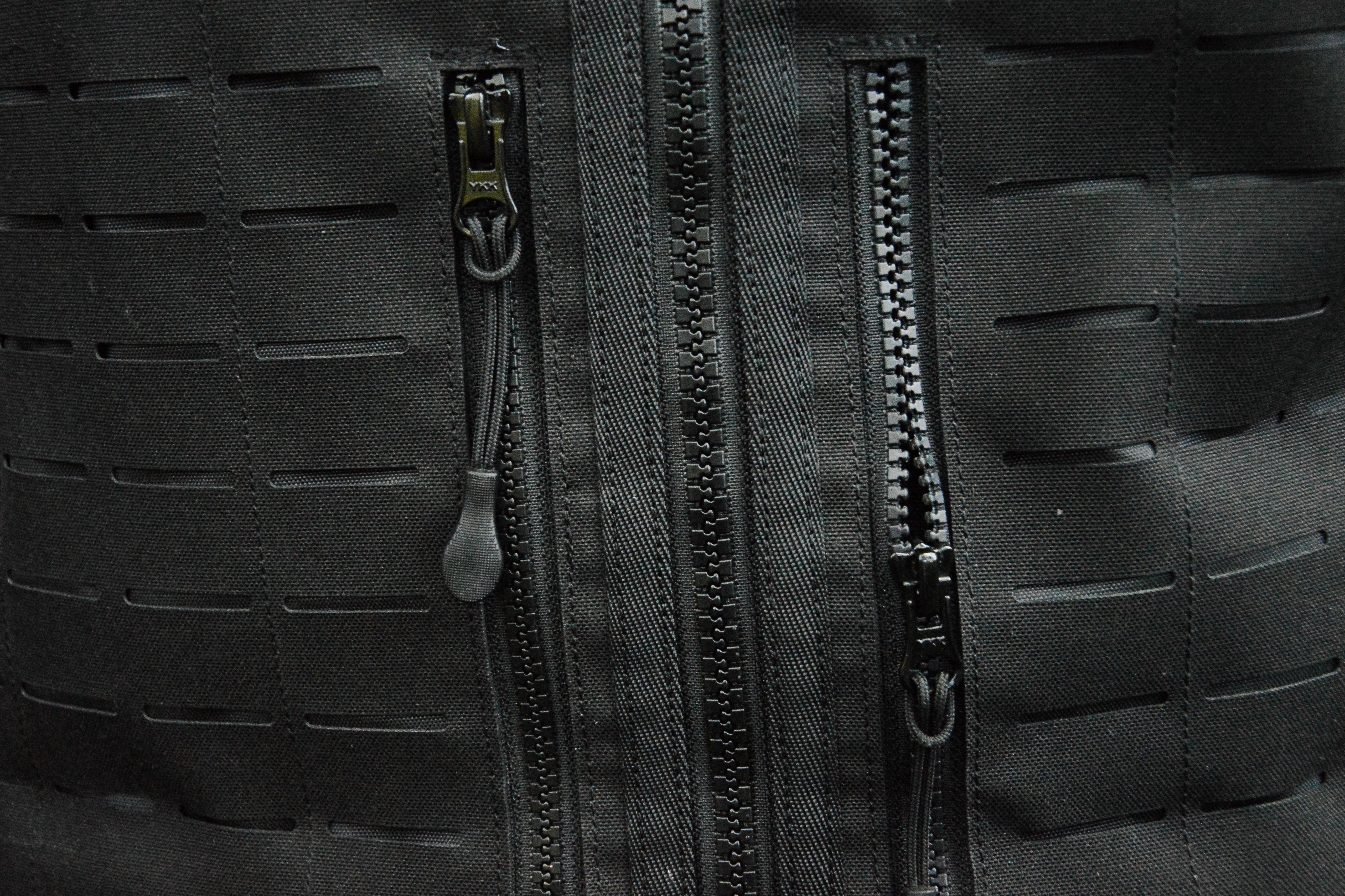
Today, bulletproof vests are experiencing an explosion of innovations: advanced sewing techniques, perfected Quick Release systems, optimized Velcro placement, laser cuts, breathable fabrics... These improvements are very real, but they come at a cost. Some drive up the price of equipment to the point of making it inaccessible for certain services, or worse: they stray from the real needs on the ground.
Because a good vest is not the one that makes engineers dream, it's the one that meets the daily operational needs of the wearer. As municipal officers often say: "I need a vest with MOLLE and the ability to insert my plates, nothing more."
So, why does each profession need a specific vest?
Police: robustness, modularity, and long-term comfort
The police are a special case. As first responders to most high-risk situations, officers must wear NIJ 3A protection, adapted to the most common threats. Their vest must be robust and extremely modular, with plenty of MOLLE webbing to accommodate notebooks, handcuffs, batons, magazines, Tasers, gas, radios, etc.
In recent years, police vests have evolved considerably:
Initially oriented towards massive and resistant vest centers
Then towards more lightweight and ergonomic solutions, inspired by the military world.
More and more municipal police forces are turning to hybrid models, used by the gendarmerie: integrated NIJ 3A protection, with the possibility of adding heavier plates for critical interventions. The need for lightness and comfort is paramount: an officer wears their vest for more than 12 hours a day. Therefore, there's no need to aim for NIJ 4, which is far too heavy and oversized for their threats. The right choice: a flexible, breathable, and well-balanced NIJ 3A vest.
Army: maximum protection and fragment resistance
The army, on the other hand, has a completely different set of specifications. Its soldiers need NIJ 3A to NIJ 4 protection, capable of withstanding wartime projectiles and explosion fragments. The heavy 360° vest retains all its legitimacy here. Contrary to some misconceptions, it not only protects against bullets but also against shell fragments, mines, and IEDs, which are responsible for a large proportion of serious injuries.
The prolonged wearing of the vest is less constant than in the police, except in external or internal operations. Again, everything is a matter of mission: snipers, forward observers, JTAC, special forces... each unit has specific needs, balancing mobility, endurance, and armor.
The regular army, meanwhile, tends to seek lighter and better-ventilated solutions, while maintaining a high level of protection.
Private security: lightness and discretion
Private security guards do not need wartime protection. Their priority: lightness, mobility, and knife protection. No need for complex stitching or tactical design: a simple, breathable, discreet vest under a shirt, which is forgotten while ensuring good frontal and dorsal coverage.
Emergency services: speed and comfort above all
Paramedics or medical responders need speed and comfort. Their vest must be easy to put on, allow quick access to equipment, and not hinder medical procedures. Discretion and flexibility take precedence over modularity.
NGOs and reporters: versatility and autonomy
For NGOs, field journalists, and war correspondents, the priority is full protection and simplicity. They often fund their own equipment, which requires finding the right balance between cost, security, and comfort. The vest must be able to accommodate NIJ 3A or NIJ 4 depending on the mission areas, while remaining light, breathable, and quick to put on, as these users are not accustomed to carrying heavy loads.
Conclusion
Each profession has its constraints, wear times, threats, and budgets. Trying to impose a single model means forgetting that ballistic protection is not just a matter of standards: it is above all a matter of field experience, comfort, and adaptation. The right vest is the one that fits the mission, not the one that costs the most.
Used in direct fire during riots, firework mortars project burning fragments and generate a blast capable of causing serious injuries. This guide details a coherent PPE ensemble (helmet + riot viso...
NIJ 0106.01 and V50: How to Evaluate the Ballistic Performance of a Helmet
When talking about ballistic helmets, performance is not just about "stopping a bullet". Unlike vests or plates, a helmet ...
Our in-house trained chatbot answers your questions 7 days a week. For direct communication, our contact page is available anytime; we're open Monday to Friday, 9 a.m. to 5 p.m.
Compliance with standards
Tested to NIJ standards, our solutions meet the strictest standards, guaranteeing their reliability.
Advanced materials
High-performance ballistic materials from renowned suppliers: Kevlar® (DuPont), Dyneema® (Avient) and Spectra® & GoldShield® (Honeywell).



Leave a comment
This site is protected by hCaptcha and the hCaptcha Privacy Policy and Terms of Service apply.